Andreas Nieder's crows process visual evidence at double primate speed
Researchers at the University of Tübingen found that birds solve visual motion tasks in 0.5 seconds, half the time required by monkeys.
By Alessia Desai ·
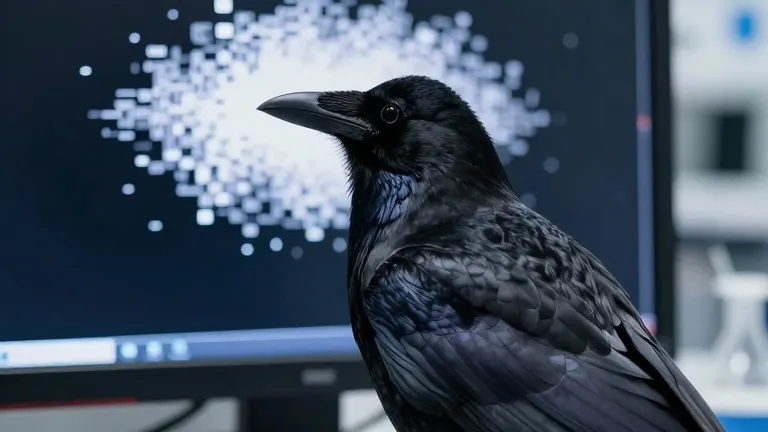
Andreas Nieder, a neurobiologist at the University of Tübingen, led a team that placed two hand-raised carrion crows in a laboratory setting to test their visual processing capabilities. The researchers aimed to determine how avian brains, which lack a neocortex, handle the same decision-making challenges that primate brains manage through established neural pathways.
The experiment utilized the random-dot-motion task, a standard tool in neuroscience. In this test, a cloud of flickering specks drifts weakly in one direction. The subject must identify the direction of movement. In primates, neurons in the neocortex collect visual evidence over time. Their firing rates climb until they cross a threshold, triggering a committed choice.
Nieder and colleague Philipp Schmidbauer recorded the brain activity of the crows as they performed the task. The birds sat in front of a touch-sensitive monitor displaying white dots on a black background. Some fraction of the dots drifted together to the left, right, up, or down. The crows indicated their decision by pecking one of the targets flanking the display. A correct answer rewarded the bird with a mealworm.
The team varied the difficulty of the task by adjusting the coherence of the dot movement. At the easy end, 81 percent of the dots moved coherently. At the hardest end, only 3 percent moved together, a level barely distinguishable from noise. The researchers also included a condition with 0 percent coherence, where no correct answer existed.
Nieder stated that the team intentionally kept the setup identical to the monkey version to ensure a direct comparison. "We intentionally wanted to have exactly the same random-dot motion task," he said. "The only difference was that the crows had to peck to indicate their decision, whereas monkeys were indicating by making an eye movement."
The crows solved the task using the same mathematical logic as primates, despite their brains being organized differently. They reached their decisions twice as fast as the monkeys. This finding indicates that a brain without a neocortex can arrive at decisions through a comparable process.
Source: Ars Technica