ESA and JAXA place BepiColombo in Mercury orbit
The joint spacecraft arrived Saturday after an eight-year voyage, though a software glitch shortened its final thruster burn.
By Meera Fletcher ·
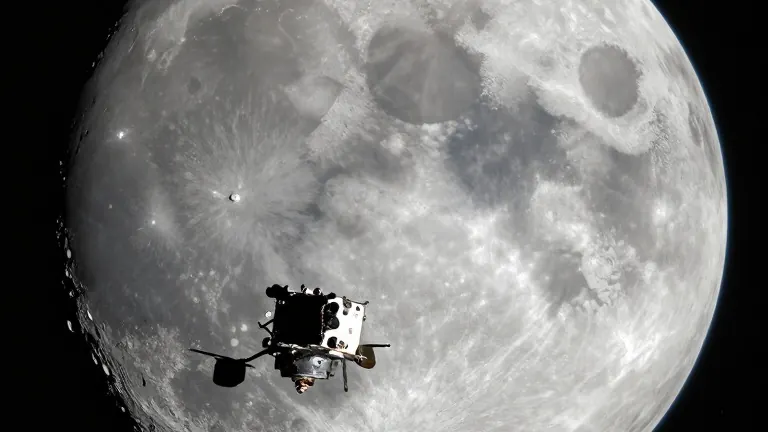
Mercury is the smallest planet in the solar system and sits closest to the sun. On Saturday, November 21, the European Space Agency and the Japanese Aerospace Exploration Agency confirmed that the BepiColombo spacecraft has entered orbit around that planet. This marks the second time in history that a human-made object has successfully achieved this milestone. The journey began in 2018, meaning the vehicle spent eight years traveling through space before reaching its destination.
The mission comprises two distinct probes working in tandem. The ESA operates the Mercury Planetary Orbiter, while JAXA controls the Mercury Magnetospheric Orbiter, known as Mio. Together, they will analyze the planet's magnetic field, its surface composition, and its internal structure. The path to Mercury required a complex trajectory involving one flyby of Earth, two of Venus, and six of Mercury itself. Engineers designed this route to counteract the intense gravitational pull of the sun, which otherwise would have made the insertion into orbit nearly impossible.
The arrival was not without technical challenges. During the critical orbital insertion phase, a software issue caused the thruster burn to last less time than planned. Despite this deviation, mission controllers report that the spacecraft remains safe and stable. The engineering teams are currently investigating the root cause of the software error. They intend to release detailed updates on their findings on Monday.
The mission bears the name of Giuseppe "Bepi" Colombo, an Italian scientist who contributed to early spaceflight theories. Scientific operations are scheduled to commence in April 2027. At that time, the two orbiters will begin collecting data from different vantage points. This dual-perspective approach allows researchers to build a more comprehensive model of Mercury and its place within the solar system.