Tala Hadid Explores Moroccan Equestrian Traditions in Documentary 'Bardi'
The director spent over four years embedded with a brotherhood of riders to capture the Tbourida ritual, blending intimacy with creative experimentation.
By Alessia Desai ·
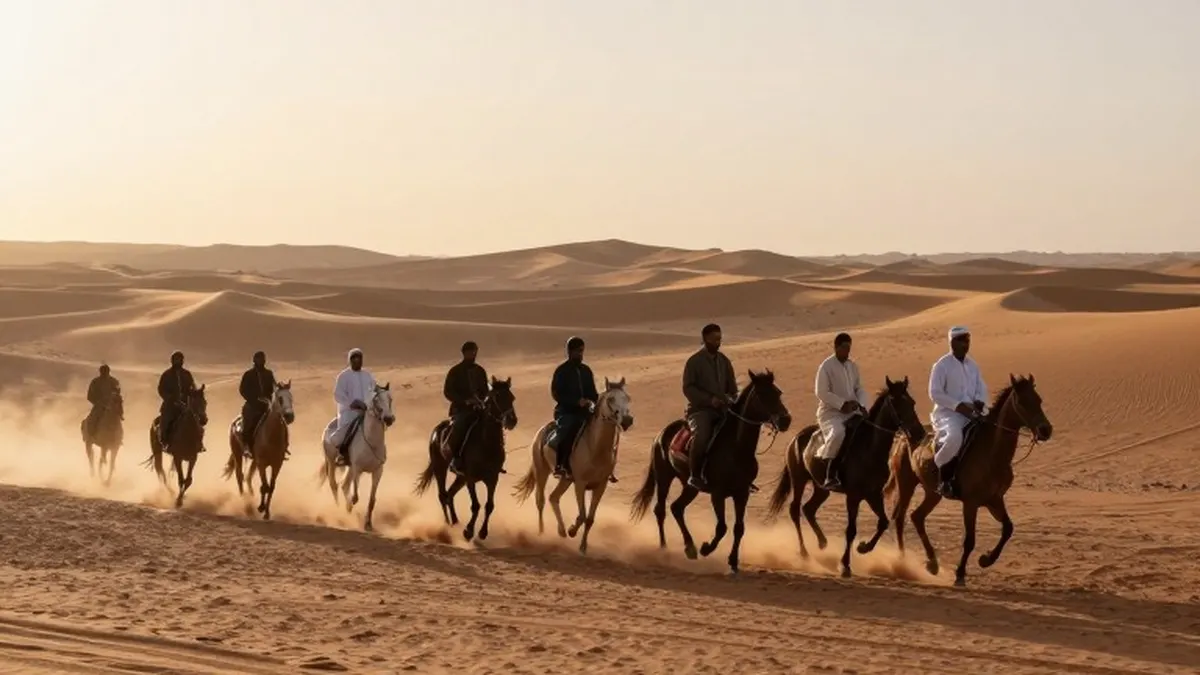
Tala Hadid spent more than four years living among the Moroccan communities involved in the Tbourida, a centuries-old equestrian ritual rooted in warfare. In this practice, horsemen charge in a single line and fire their rifles in calculated alignment. Despite her deep immersion, the filmmaker stated that she feels she has only scratched the surface of the intricate world she documented in her new film, Bardi. The documentary follows a brotherhood of riders and observes the families involved, highlighting the close relationship between young men and their animals as they transform into mythical figures on their saddles.
Hadid, who is also a photographer with work displayed at institutions like the Museum of Modern Art in New York, handled the cinematography for the project. This choice allowed her to keep the production team small and nimble while following the men over several years. Speaking with Variety after presenting the film at the Doha Film Festival, IDFA, and Marrakech, she recalled her initial encounter with the riders. She described the scene as impressive and sublime, which sparked a need to ask further questions about the tradition.
The director noted that the border between the camera and the filmmaker is porous when meeting new subjects. She emphasized the need for patience, explaining that the process is similar to being a guest in a home where different people come and go. Because the fraternity is a broad collective often numbering between 30 and 40 members, it took time to identify who she wanted to focus on. She noted that the community members were gracious and welcoming throughout this period.
Hadid explained that she did not approach the project with a desire to make a sociological or journalistic film. Instead, she sought to understand the men and the ritual more closely. As a woman who is half-Moroccan, she questioned how well people truly know their own culture and country. These questions led her to approach the work with humility, allowing her to learn about the mythology and beliefs entrenched in the community.
She described entering a terrain that was totally unknown to her, comparing her perspective to that of an alien. Even after four and a half years of filming and a year of editing, she believes she only knows a little bit. Hadid views cinema as a mysterious medium where what lies outside the frame is as important as what is captured, meaning a total view is rarely possible.
This understanding influenced the film's form, which plays with notions of fact and fiction. Hadid introduced fictional elements and fabulation around three years into filming, once intimacy had been established. She explained that people perform when a camera is present, and she viewed this interaction as a game. She does not believe in strict boundaries between fiction and documentary, arguing that the moment an image is cut, it ceases to be purely real. Editing is a choice that transcends the moment, creating a no man's land between the two genres.
One specific example of this approach involved a scene where a father tells his daughter she cannot ride alongside her brothers. This was a recreation of a real moment shared with Hadid. She asked them to repeat the scene, noting that the father did not need to act because the emotion was genuine. She described the process as almost therapeutic, creating an intense space for the participants.
Hadid concluded by stating that while she does not consider Bardi revolutionary, she believes in the importance of shaking audiences. She aims to awaken the eye and avoid repeating the same films, using the power of the image to re-look at familiar subjects.
More News · National news · Report a business · Got a Story?