Hernández-Bernal's Sorbonne Model Solves Arsia Mons Cloud Mystery
A new study in Nature Geoscience suggests the 1,000-mile Martian cloud forms via a rare ice process requiring humidity 100,000 times higher than Earth's.
By Tomas Rahman ·
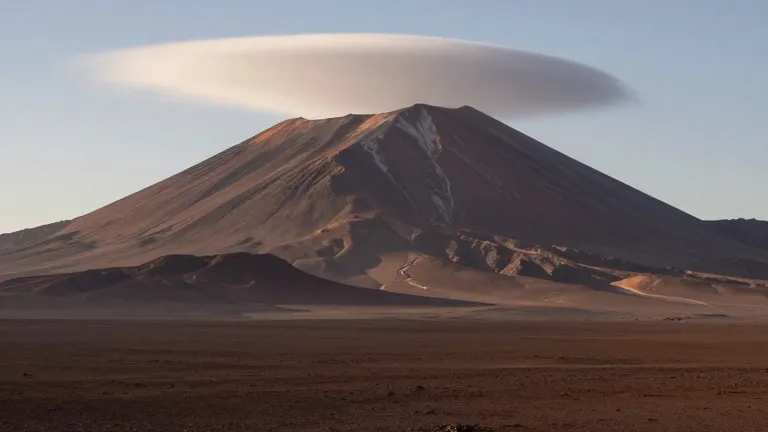
Jorge Hernández-Bernal and his team at Sorbonne Université have produced the first computer model that successfully replicates the formation of the Arsia Mons Elongated Cloud. The daily feature, which stretches over 1,000 miles near a massive Martian volcano, has defied explanation since its discovery. The researchers determined that the cloud only appears in their simulations when they incorporate a specific physical process that has never been directly observed in a planetary atmosphere.
The cloud, known as AMEC, emerges during Martian spring and summer. It grows longer throughout the morning until it spans a distance comparable to the straight-line route from New York to Kansas City, before dissipating. A probe first captured images of the feature in 2018, leading scientists to search for a mechanism that could generate such a vast structure on a planet with a thin atmosphere.
The study, published in Nature Geoscience, identifies homogeneous nucleation as the driving force. On Earth, clouds typically form when water vapor condenses around dust or salt particles. The new model proposes that on Mars, vapor turns directly into ice crystals without any solid debris to seed the process. Hernández-Bernal described this mechanism as appearing in textbooks but generally considered theoretical, noting that it was treated as unlikely to occur in nature.
To trigger this direct condensation, the atmosphere must reach extreme conditions. The model requires a temperature drop of 30 degrees Celsius within 10 minutes, alongside high relative humidity. The 65,000-foot Arsia Mons volcano creates these conditions when wind collides with its slope, generating a powerful wave that lifts moist air high into the atmosphere in minutes.
The humidity levels required for this process exceed any value measured on Earth by more than 100,000 times. Scientists had previously assumed similar nucleation could occur in the upper atmospheres of Earth or Venus, but the lack of observed examples suggested the necessary moisture was absent. The new findings indicate that such extreme humidity does exist on Mars, a detail that was previously unknown.
Hernández-Bernal called the emergence of the cloud in the simulation "wholly unexpected" and "remarkable." He noted that far less is known about the Martian atmosphere than Earth's, making the accurate reproduction of the cloud a substantial achievement. The work confirms that the daily cycle of cloud growth and disappearance relies on physics that planetary scientists have long suspected but never confirmed.
The research team published their findings in Nature Geoscience, providing a concrete explanation for the AMEC. The model demonstrates that the interplay between the volcano's topography and the atmosphere's unique humidity profile creates a daily weather phenomenon that had previously remained a mystery to observers on Earth and in orbit.
Source: Wired