Lebanese family rebuilds after Israeli army leaves their burned home
The Kadouh family returned to their village in July to find their house destroyed, their trees uprooted, and no utilities to support their daily lives.
By Alessia Desai ·
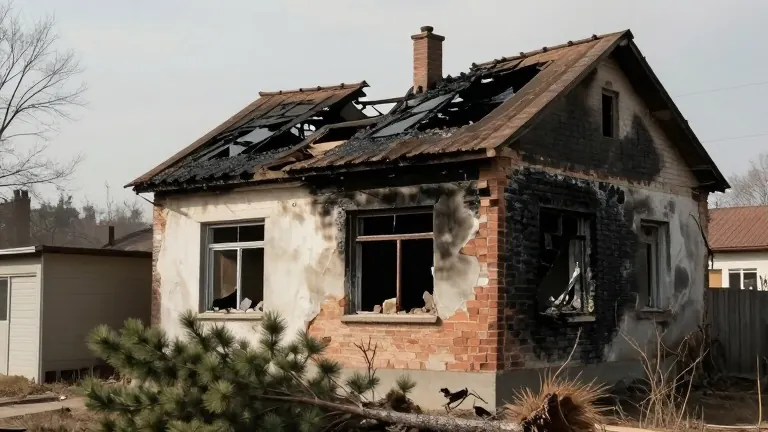
Lebanese villagers have begun returning to their homes in southern Lebanon following a U.S. brokered withdrawal of Israeli forces. This return marks the first test of a plan designed to allow the Lebanese army to take over security duties from Israeli troops. The goal of the arrangement is to prevent Iran backed Hezbollah from reestablishing a military presence in the border zone.
The Kadouh family, including Atef Kadouh and his wife Soumaya Yaghi, moved back into their home in Zawtar al Gharbiyah in July. They had lived in the house for 40 years and raised five children there. The family now has four children after the death of their youngest son, Adel, on March 28. Adel was a sports teacher and ambulance driver who died in a drone strike while helping to bury a 75 year old man.
Atef Kadouh stated that his son was not a fighter at the front and was rescuing wounded people when he was killed. He noted that Israel could not be trusted to spare medical personnel. "He would not listen to me. He said, 'Dad there are wounded children, we have to go rescue them,'" Kadouh said. Lebanon's Health Ministry reports that Israel has killed more than 135 first responders and medical staff in the past two years. The Israeli military responded that militants often pose as paramedics but did not provide proof that the five men killed on March 28 were in an ambulance.
Upon their return in July, Kadouh and Yaghi found that Israeli soldiers had occupied their house before setting it on fire. They discovered a work roster written in Hebrew on the hallway walls and bullet holes in their appliances. Furniture and some appliances had been pushed over the second floor balcony. In the kitchen, floor tiles were shattered and cupboards were wrenched from the walls. Burned food packets and rotting sandwiches lay on the floor, suggesting the fire was set as the soldiers left.
The house lacked running water and electricity because the Israeli military destroyed the solar panels. The Lebanese army informed the family that it dismantled explosives left by Israeli forces in their home and other houses in the village. Yaghi found multiple bullets throughout the house and a spent engine casing with English markings that read "propulsion unit, tactical". Kadouh saw a tank in their courtyard through drone images posted on social media while Israeli forces were still present.
Yaghi stated that the Israeli army used a bulldozer to uproot trees, including pine trees that produced a key cash crop for the family. They also demolished the family's garage and destroyed their tractor. Kadouh described the damage as exceeding what they expected from satellite photos. "Everything that could be broken they broke," he said. The destruction of the trees cut the deepest for the family, who had tended them for decades. Yaghi pointed out where fruit bearing cactus, olive trees, and avocado trees once stood.
The family feels abandoned by the Lebanese government and local political parties. Kadouh noted that no one came to check on them after their homes were destroyed. He said the Lebanese army is deliberately underequipped to avoid presenting a threat to Israel, which has prevented it from protecting the villagers. "The Lebanese state never sent a soldier here to protect us," Kadouh said. He added that the state has left a vacuum that brought the tragedy. Despite the lack of utilities and security, Kadouh said they would rather sit in the dirt in their home than live outside.
Israel's defense minister has acknowledged destroying more than 20,000 homes across the Lebanese border in a self declared security zone. The Israeli army did not reply to queries about why the Kadouh house was damaged or set on fire. It stated that military policy bars burning homes or leaving explosives. Smoke rises from a nearby village where Israel is still attacking despite the ceasefire. Kadouh said he is not ready to make peace with Israeli Prime Minister Benjamin Netanyahu. "Netanyahu is the one who killed my son. Let him bring back my son," he said.