Lunar Water Shortage Could Limit Moon Cities to One Million Residents
New research indicates that despite optimistic timelines from major tech leaders, the moon's limited water reserves may only sustain a population of one million for a century if recycling is near perfect.
By Mykola Bondarenko ·
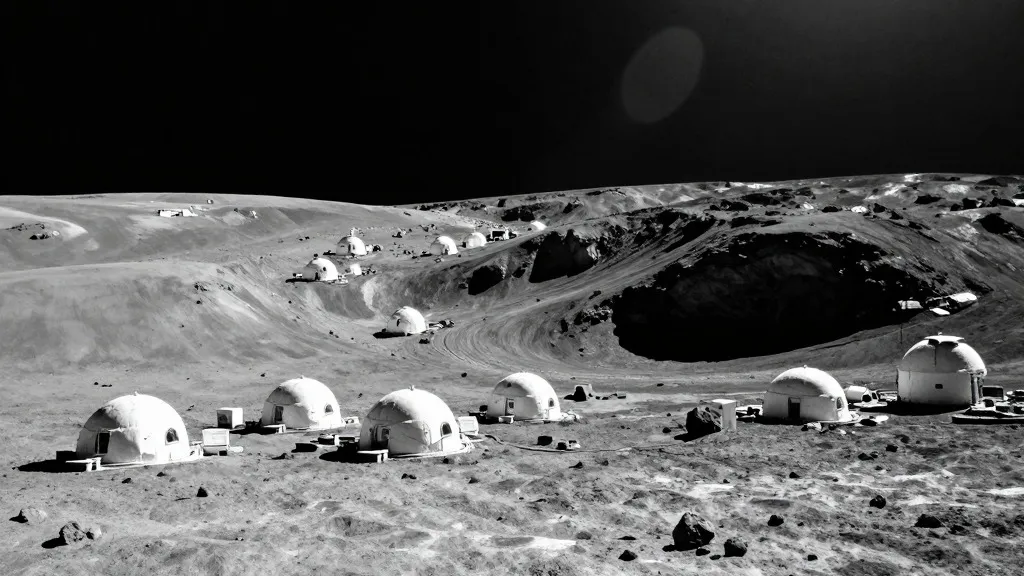
A new study suggests that the moon's water supply is too scarce to support the large scale settlements envisioned by prominent technology leaders, potentially capping a major city at one million people for roughly a century. This finding challenges the rapid growth timelines recently proposed by industry giants who believe lunar habitation is imminent.
The analysis, published in Frontiers in Space Technologies, was conducted by Martin Elvis, a senior astrophysicist at Harvard University's Smithsonian Astrophysical Observatory, and Jonathan McDowell, an honorary professor at the Durham University Space Research Centre. Their work responds directly to public statements made by executives in the private space sector regarding the feasibility of large scale off earth living.
In February of this year, Elon Musk, the chief executive of SpaceX, announced on social media that his company had pivoted its primary focus from Mars to creating a self growing city on the moon. He estimated this could be achieved in under ten years, a timeframe he argued was significantly faster than the more than two decades required for Mars settlement. Jeff Bezos, the head of Blue Origin, has also projected that millions of people will reside in space by 2045. These bold claims prompted Elvis and McDowell to scrutinize the underlying physical constraints.
The researchers identified two critical resources for sustaining human life: power and water. Their analysis found that generating energy is the more manageable challenge. Both solar and nuclear options appear sufficient to support one million people on the lunar surface. However, the availability of water presents a far tighter constraint on the scale of possible settlements.
While water does exist on the moon, it is concentrated in permanently shadowed regions near the poles where sunlight does not reach. Current estimates suggest there is approximately one billion tonnes of this resource. Under the assumption that a settlement recycles 98 percent of its water, a rate comparable to that achieved on the International Space Station, a population of one million would be sustained for only about 100 years. This duration assumes the full volume of estimated water is accessible and usable.
Elvis described the total volume as modest when viewed in context. He compared the amount to an aquarium the size of Central Park filled until the Statue of Liberty was just submerged. He noted that while it sounds like a large quantity, it is effectively a small lake that cannot supply a major city for an extended period. This perspective underscores the difficulty of maintaining long term infrastructure without a renewable source of fresh water.
Smaller communities face less severe limitations. A town of 10,000 residents could be sustainable for centuries under the same recycling assumptions. McDowell argued that if the goal is to populate the moon with cities similar to those depicted in science fiction, new methods must be developed to transport water to the surface. He emphasized that the current static reserves are insufficient for such expansive urban development.
The baseline figures used in the study may themselves be overly optimistic. Elvis suggested that the estimate of one billion tonnes could be 20 or 30 times too high. Furthermore, he posited that only one third to one half of the present water would likely be recoverable. His best assessment is that the reliable supply is about one percent of the original figure, which would reduce the 100 year sustainability window for one million people to just one year.
The physical state of the lunar water adds another layer of complexity. Gordon Osinski, a professor of planetary geology at Western University in London, Ontario, noted that satellite measurements contain uncertainties. He believes the water is present but requires on ground confirmation to verify its accessibility. He suggested it may resemble Arctic permafrost, consisting of sub millimetre ice crystals mixed into soil, which would be difficult to extract efficiently.
Despite the constraints, the researchers do not view the findings as a definitive barrier to progress. McDowell stated that the truth is never negative, and that the real problem lies in attempting projects that are not viable. The study serves as a technical check on ambition, highlighting that engineering solutions for water extraction and recycling will be as crucial as rocket technology for the future of lunar habitation.
Source: CBC News