Three Nations Plan Islamabad Summit to Fortify Regional Defense Pact
Pakistan, Saudi Arabia, and Turkey are preparing for a high-level meeting in Islamabad to address challenges facing their new collective defense agreement.
By Meera Fletcher ·
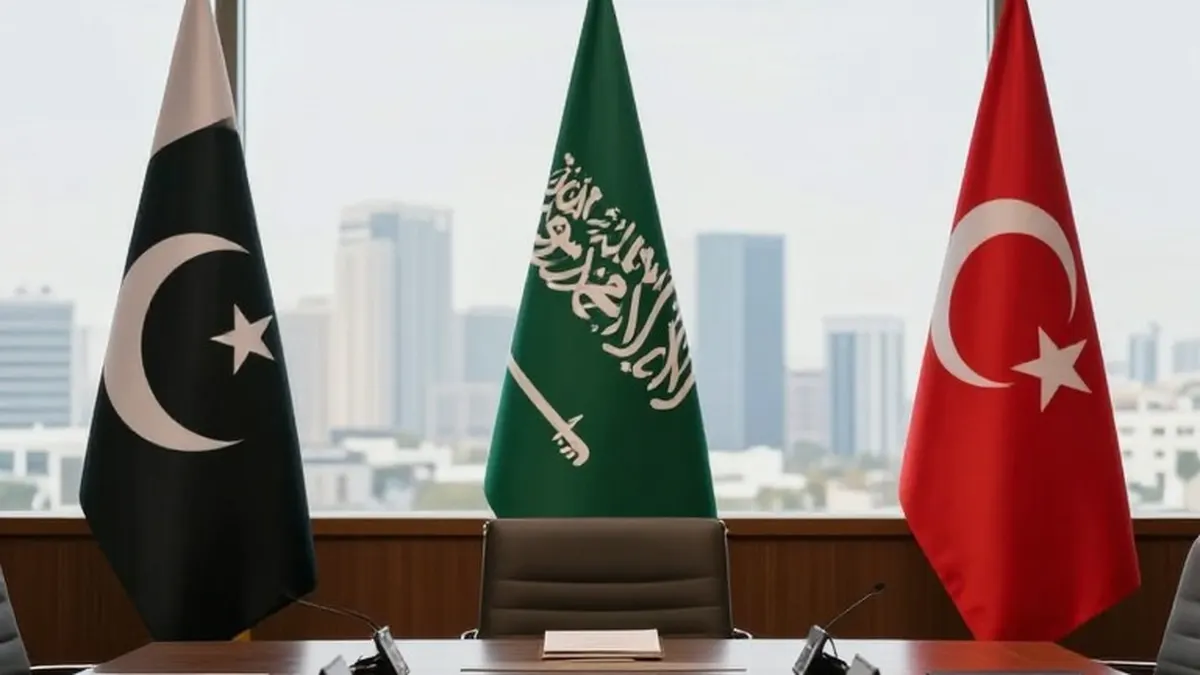
Pakistan, Saudi Arabia, and Turkey are moving to strengthen their emerging defense alliance as instability continues to rise in the Middle East. According to reports from Reuters, the three nations intend to hold a significant meeting in Islamabad on November 27 and 28. The gathering will focus on discussing the terms and implementation of their mutual defense agreement.
The report, which was based on information from two Pakistani sources, indicates that the foreign ministers of Saudi Arabia and Turkey are expected to attend the session. While Arab News in Saudi Arabia did not immediately confirm the details of the summit, the potential meeting highlights the growing importance of this tripartite security arrangement.
The alliance was formally established when the three countries signed a joint defense agreement in Mecca in August. This pact was created in response to concerns regarding the ongoing conflict involving Iran, Israel, and the United States. The agreement is modeled on NATO principles, stipulating that an attack on any one member is considered an attack on all three.
Recent developments have placed immediate stress on the new partnership. Renewed fighting between Saudi Arabia and the Iranian-backed Houthis in Yemen has presented a significant challenge. The Houthi attacks have raised questions about how the alliance intends to translate its defensive commitments into practical action, particularly given that Saudi Arabia has been engaged in an off-and-on conflict with the group since intervening in Yemen in 2015.
Pakistan has found itself in a complex diplomatic position. While the country has played a key role in mediating between the United States and Iran, it must also balance these efforts with its new commitments to Riyadh. In September, Pakistani Foreign Ministry spokesperson Sajjad Haider Khan stated that there was no military response under discussion at that time, despite the Houthi attacks exposing the complexities of implementing the agreement.
Turkey has also approached the situation with caution, distinguishing between providing defensive assistance and participating in offensive operations. In October, Reuters reported that Ankara was primarily offering technical and defensive support to Saudi Arabia. However, analysts suggest that the true test of the alliance is not just military readiness in Yemen, but the ability of the three nations to institutionalize their partnership despite early hurdles.
The agreement extends beyond simple mutual defense to include cooperation in the defense industry, joint military exercises, and intelligence sharing. It also establishes a permanent secretariat in Saudi Arabia and leaves the door open for other countries to join. In early October, the nations agreed to begin implementing collective defense commitments, which may involve the deployment of military capabilities to Saudi Arabia.
The alliance also serves as a diplomatic tool. Senior officials from the three countries held talks in Tehran on October 26 to reduce regional tensions. This provides Riyadh with another mechanism to apply pressure on Iran regarding the Houthi attacks. For Israel, the growing power of this alliance is significant, as it brings together a nuclear state, a major military power with a growing defense industry, and a wealthy nation capable of funding long-term modernization.
This development reflects a broader shift in the region, where local powers are taking more initiative in shaping security architecture rather than relying exclusively on Washington. While the Abraham Accords focused on normalization and economic ties, the Mecca agreement emphasizes military security. These models are not mutually exclusive, as Israel and Saudi Arabia share an interest in confronting the Houthi threat.
The upcoming meeting in Islamabad will serve as a critical indicator of whether the agreement can evolve into an enduring regional alliance. Although the Houthi attacks have complicated the process, they may also provide the impetus needed for the members to accelerate their cooperation and solidify their collective stance in the region.