Scientists send word through brick wall using elevator gravity
University of Queensland researchers used a 1950s lift and a sensitive detector to transmit the word 'gravity' in binary code over 70 centimeters.
By Tomas Rahman ·
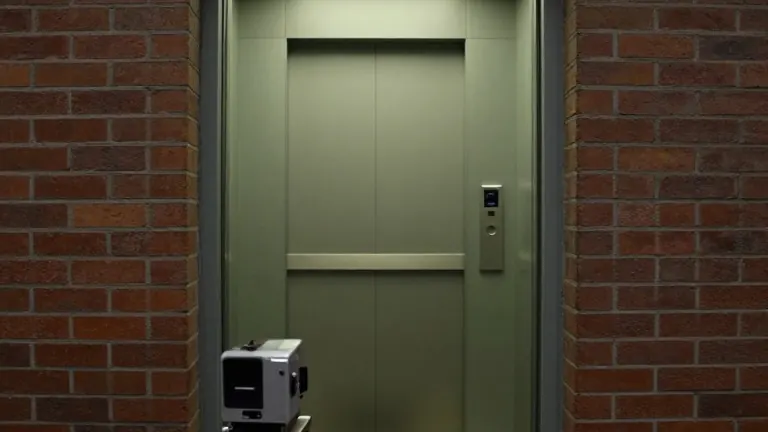
Australian scientists have demonstrated a method of sending information through solid matter using gravity.
The proof-of-concept experiment was conducted at the University of Queensland. It involved a slow-moving 1950s elevator, a brick wall, and a men's bathroom. The team successfully transmitted a message roughly 70 centimeters through the brick partition.
The researchers utilized a sensitive detection device called a gravimeter. This instrument was positioned on the floor of a bathroom directly adjacent to the elevator shaft. The gravimeter monitored the gravitational field as the elevator moved between two floors.
The elevator contained a 1.8-tonne counterweight. As this weight shifted between the two levels, it created detectable changes in the local gravitational field. The scientists mapped these shifts to binary code. The upward and downward positions represented the digits 0 and 1.
The team chose to transmit the word "gravity." In binary, this word consists of seven letters. At a transmission rate of one bit per minute, the process took nearly an hour to complete. The signal passed through the brick wall to the receiver in the bathroom.
Co-author Dr. Charles Woffinden of the school of mathematics and physics noted the unique advantage of this system. He stated that gravitational signals cannot be screened out by ordinary materials. He observed that anyone who has lost phone reception in a tunnel or struggled with Wi-Fi through a solid wall would understand the appeal of such a scheme.
Professor Matthew Davis, a co-author of the study, acknowledged the current limitations of the technology. He said it is difficult to imagine how the method could become practically useful given its extreme slowness. He compared the speed to NASA's Voyager 1 spacecraft. After 49 years of travel, Voyager 1 is one light-day away. Davis noted that the spacecraft communicates with Earth at a faster data rate than the new concept.
Davis explained that the method could theoretically work at ranges of up to 500 meters. He said a rate 15 times faster is possible if more sensitive quantum gravity sensors are employed. The idea originated from a project to develop a contactless weighbridge. That project aims to use quantum sensors to detect gravity changes from passing trucks to determine vehicle mass. Classical gravimeters function like a mass on a spring. The bounce rate changes if the gravitational field shifts slightly. Quantum sensors are still under development. The team also noted that other near-unblockable methods involving neutrinos or gravitational waves are hindered by the difficulty in generating measurable signals. The experiment took place in the Parnell physics building, which also hosts the pitch drop experiment that began in 1927.