320,000 Protesters March in France as Police Deploy 70,000 Officers
Demonstrations across France and Europe focused on education and living costs saw a drop in attendance compared to the previous weekend, while authorities tightened security measures in major cities.
By Tomas Rahman ·
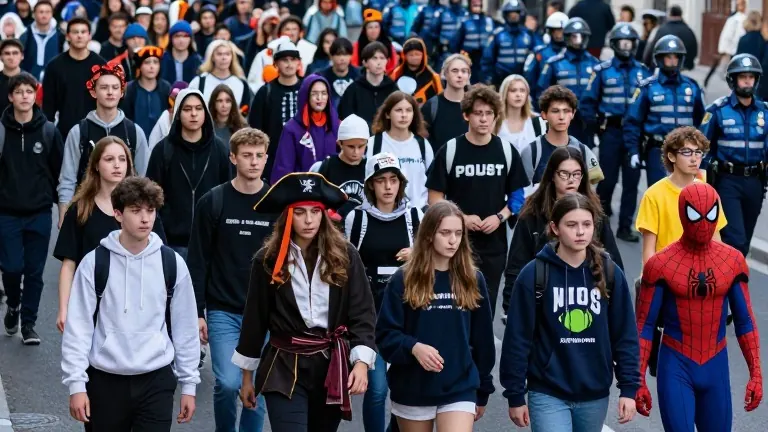
Protests in France attracted an estimated 320,000 participants on Saturday, a decline from the previous weekend but a continuation of a three-week series of demonstrations. The gatherings, which focused on high school conditions, university admissions, and the rising cost of living, saw a large police presence designed to prevent the unrest that marred earlier events. About 70,000 police and gendarmes were deployed nationwide, with routes in Paris rerouted to the city’s edge to keep marchers away from central government buildings and tourist sites.
The current movement began in October with high school students protesting deteriorating school infrastructure and a perceived bias in university admissions against disadvantaged students. Labor unions and other groups joined the effort, adding demands related to President Emmanuel Macron's policies. While the initial rallies were smaller, turnout grew to over 500,000 on Oct. 17 and 410,000 on Oct. 24, according to government figures. Organizers typically cite higher numbers, but the Interior Ministry's estimates show a downward trend in this latest round of marches.
In Paris, approximately 70,000 people participated in the main march. The route was altered following a last-minute court battle to reduce the risk of unrest near sensitive locations. At Porte de Bagnolet, a gathering point on the eastern edge of the city, students led the march hand in hand. Security agents from the CGT labor union monitored the front lines, while police massed on adjacent side streets. Marchers included high school students, climate activists, and workers citing inflation, with some wearing Halloween costumes to maintain a festive atmosphere.
Interior Minister Laurent Nuñez warned of a high risk of disorder, particularly after dark. He cited incidents from previous weekends where riots and looting followed largely peaceful marches. Police arrested thousands in those prior events. To manage the current crowd, authorities used tear gas, dispersion grenades, and water cannons when troublemakers targeted officers with fireworks and projectiles. Some protesters suffered severe injuries during these confrontations.
Corentin Cabreux, a 21-year-old student, described his living conditions as part of the grievances. He noted damp stains, peeling walls, and infestations of cockroaches and rats in his state-run residence. He hoped the Halloween-themed march would project a peaceful image to counter the violence seen in earlier protests. The government also implemented specific curfews, barring people from Place de la Republique and Les Halles from 11 p.m. to 6 a.m., and imposing a 9 p.m. curfew for unaccompanied minors near the Champs-Elysees.
Similar demonstrations occurred in Germany, where a youth initiative called Gen Z regelt rallied in multiple cities. Organizers reported more than 180,000 online sign-ups, though only several thousand marched in various cities by Saturday afternoon. In Berlin, protesters gathered at the Brandenburg Gate demanding investment in education and housing. Lara Breitenbach, a high school student, stated that the generation would bear the long-term costs of political decisions. Janelle Schulz, another student, pointed to water damage and broken facilities in her school as evidence of neglect.
German authorities deployed an additional 1,500 police officers to Berlin and boarded up shop windows on the Kurfuerstendamm boulevard as a precaution. In The Hague, Netherlands, a strong police presence guarded the downtown shopping area following online calls for protest. Despite fears of rioting, little activity was observed by midafternoon, and police checked the identities of some groups of young people. In Barcelona, regional police prepared to activate their highest alert level after a TikTok network called Blocus urged new gatherings, following 130 arrests during unrest on Oct. 24.
Italian police remained on alert in Milan, Turin, and Bologna after recent clashes. Calls for protest circulated on social media in Belgium, the Netherlands, Austria, Switzerland, and Portugal. The coordinated nature of these European demonstrations has prompted authorities to balance the right to protest with the need to protect public property and commerce. The next scheduled actions depend on further announcements from student leaders and labor unions in the coming days.
Source: ABC News
More Business · Business Complaints · Report a business · Got a Story?