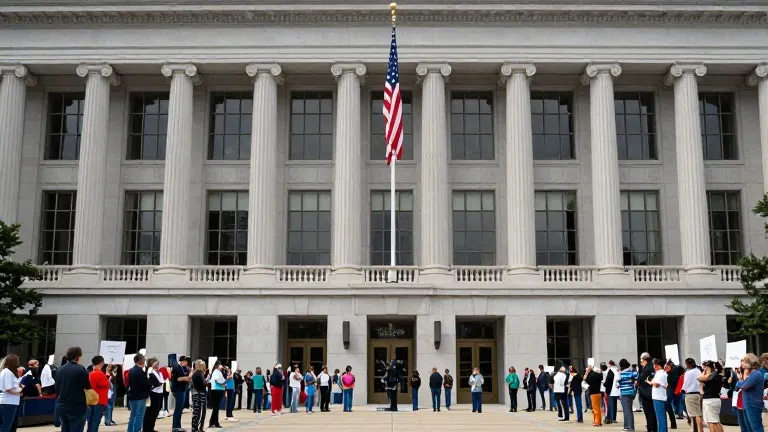
4.8 Million: Michigan Midterm Sets New Vote Record
Preliminary data shows a surge in participation across rural and urban counties, with Governor-elect Jocelyn Benson outperforming her party's other statewide candidates.
By Tomas Rahman ·
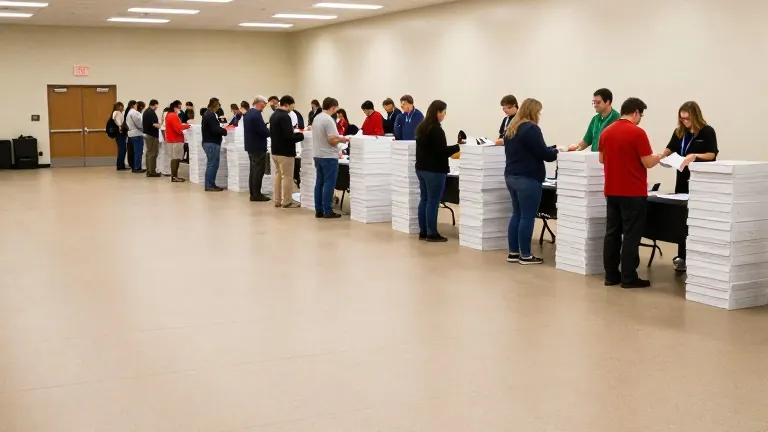
Michigan voters cast approximately 4.8 million ballots in the November 2026 general election, a figure that represents roughly 60% of the state's voting age population.
The participation rate marks a sharp increase from previous midterms. In 2010 and 2014, about 40% of eligible voters participated. The 2026 result is the highest recorded for a midterm election in the state. While many counties saw growth, the surge was not uniform. Wayne, Kent, and Washtenaw counties experienced expected increases. Rural Oscoda and Ogemaw counties also saw large spikes in voter numbers.
Despite high turnout in rural areas, the political shift was modest. In Oscoda and Ogemaw counties, the Republican margin of victory remained strong relative to the 2024 presidential election. Ogemaw was the only county where preliminary data showed a shift toward the Republican candidate in the U.S. Senate race. However, Democratic candidates Abdul El-Sayed and Jocelyn Benson underperformed compared to their party's past candidates in those specific rural districts.
Jocelyn Benson, the Democratic governor-elect, received a higher share of the vote than other Democratic statewide candidates. She outperformed U.S. Senator-elect Abdul El-Sayed, Attorney General candidate Eli Savit, and Secretary of State candidate Garlin Gilchrist in every county. Preliminary data indicates that about 1% of voters skipped the governor's race, while twice that number skipped the attorney general and secretary of state races. This pattern suggests some voters split their tickets rather than voting for a full party slate.
The August primary election saw significantly lower participation than the general election. This gap is consistent with historical trends, as primary voters tend to be more partisan and older. In the U.S. Senate primary, Congresswoman Haley Stevens received nearly twice as many votes in Detroit as El-Sayed. However, El-Sayed performed well in the general election, securing a larger percentage of the Detroit vote than Elissa Slotkin did in 2024. His results were similar to those of Gary Peters in 2020 and Debbie Stabenow in 2018.
Voting methods varied by preference, with at least 40% of Michiganders submitting ballots by mail or drop-off. A smaller group utilized early in-person polling centers, which were required statewide for the second time. Many voters still cast ballots in person on Election Day. In Detroit, turnout reached 39%, beating the 2022 total but falling slightly below the 2018 level. Grand Rapids saw a 53% turnout. Dearborn recorded the highest relative increase, with nearly 57% of registered voters participating, a rate higher than in the 2024 presidential election.
Corwin Smidt, a political science professor at Michigan State University, noted that voting is a habit-forming behavior. He stated that competitive elections and varied issues encourage repeated participation. The 2026 results will serve as a baseline for future comparisons, including the 2028 presidential primaries, where Michigan is scheduled to hold its caucus.