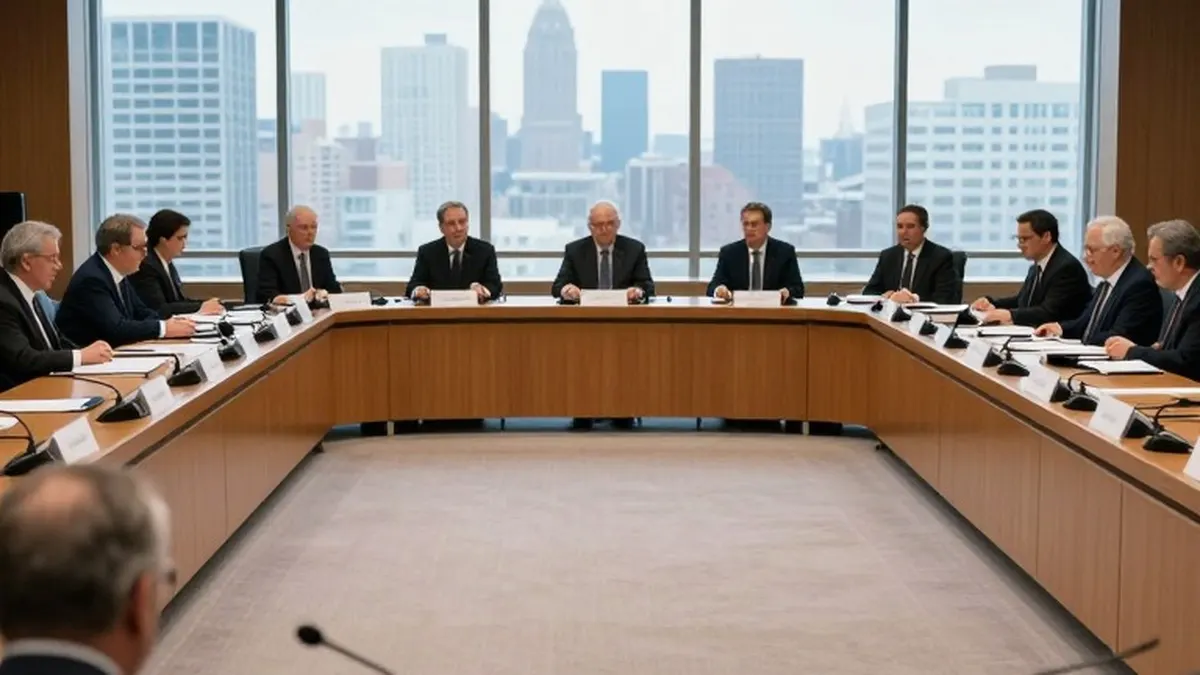
Macron considers constitutional spending caps to address fiscal concerns
French President Emmanuel Macron is weighing a constitutional amendment to limit government spending, a move supported by right-wing rivals but criticized by the left as a restrictive measure.
By Tomas Rahman ·

French President Emmanuel Macron is evaluating a proposal to impose strict limits on future government spending, a move that has drawn mixed reactions from political opponents. While right-wing candidates have welcomed the idea of a constitutional cap, they have simultaneously mocked the president for the significant deficit left after his decade in office. Critics on the other side argue that the plan acts as a financial straitjacket and serves as a distraction from the president's diminishing influence in domestic affairs.
The initiative comes after two and a half years of political instability following a disastrous snap election. Since that event, successive minority governments have struggled to pass unpopular budgets aimed at reducing the deficit through a hostile parliament. With his second and final term ending in May of next year, Macron is considering this measure as potentially his last major domestic policy contribution.
The proposal revives a concept from 15 years ago that would require a change to the French constitution. This amendment could be passed through a referendum or by a three-fifths majority in a joint session of parliament. Macron told Le Figaro that he could begin consultations with both houses of parliament as early as January if he decides to proceed. His Prime Minister, Sébastien Lecornu, is reportedly already gauging the feasibility of these options with various political parties.
The primary motivation for the move appears to be reassuring investors who are worried about France's public finances. Bond markets have shown increasing anxiety over the country's debt levels, which stand at nearly 120 percent of GDP. This figure is among the highest in the eurozone and significantly exceeds the European Union's 60 percent cap. The government projects that the deficit will reach 5.4 percent of GDP this year, well above the EU limit of 3 percent.
The Elysée Palace is closely monitoring interest rates on French bonds, which have risen in recent weeks due to doubts about the country's ability to reduce its debt load. In an interview with Le Figaro, Macron suggested that considering a golden rule similar to the one proposed in 2011 could be a worthwhile idea if volatility persists until January. The 2011 draft, which was never fully enacted, would set binding targets for returning to balanced budgets and empower the Constitutional Council to strike down legislation that violates these rules.
Political support for the principle has come from several quarters, including Macron's allies, the mainstream right, and the far-right National Rally. Marine Le Pen, the leading candidate in presidential polls, quickly claimed credit for the idea, noting that her lieutenant Jordan Bardella had proposed a similar rule weeks earlier. She expressed delight at Macron listening to Bardella but hinted that she might request amendments to the 2011 bill, which would require a new review by parliament.
Other right-wing figures, including former prime ministers Édouard Philippe and Gabriel Attal, as well as conservative candidate Bruno Retailleau, are also considering the introduction of a golden rule. Retailleau welcomed the suggestion but joked that Macron waited until the coffers were empty before deciding to put a lock on them. Political analyst Jean Petaux noted that the timing reflects a desire to repair the image of a president once called the Mozart of finance.
The left, the only bloc broadly opposed to the measure, has raised concerns about its implications. Éric Coquerel, chair of the National Assembly’s Finance Committee and a member of Jean-Luc Mélenchon’s party, warned that the rule would drastically limit future governments' ability to pursue different economic policies. The Elysée Palace is particularly concerned about the prospect of Mélenchon, who advocates for the European Central Bank canceling a portion of France's debt, qualifying for the presidential runoff against Le Pen.
Economist Clara Léonard of the Institut Avant-Garde argued that focusing on a binding rule is a distraction from the necessary work of planning a sustainable budget. She described the belief that a golden rule would solve the deficit problem as wishful thinking, emphasizing the need for a genuine medium to long-term adjustment strategy. Léonard pointed out that since 2007, half of the increase in public debt has been linked to crisis spending, such as measures to offset fuel cost fluctuations or heatwaves.
Léonard warned that the risk of the golden rule is an overemphasis on fiscal austerity at the expense of investments needed to address future costs, such as climate adaptation. She acknowledged that building consensus for such investments has been lacking in French politics, concluding that a technocratic rule alone cannot fix the political roots of France's budgetary problems.