Israeli scientists create plant-based ice 10 times stronger than standard frozen water
New material called BioPykrete uses cellulose and engineered proteins to create a biodegradable building option for extreme cold environments, including potential use on Mars.
By Tomas Rahman ·
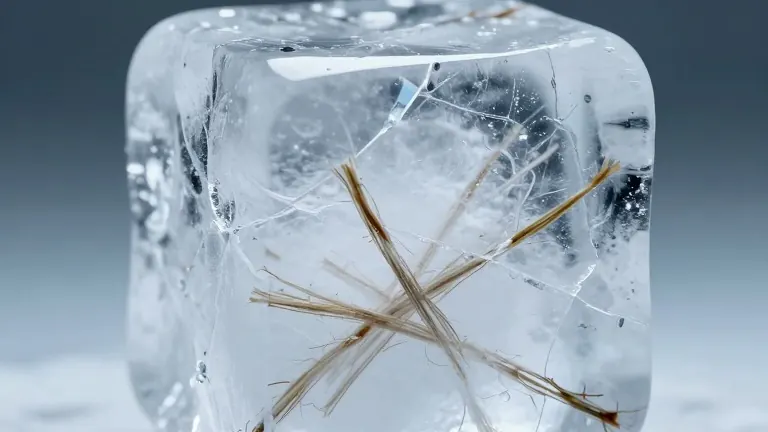
Researchers at the Hebrew University of Jerusalem have developed a molecularly bonded ice material called BioPykrete that is 10 times stronger than regular ice. The team published a study detailing the new composite, which is 70 times harder to break than ordinary frozen water. The material is designed to be an eco-friendly alternative for construction in extreme cold zones.
Professor Ido Braslavsky, the lead researcher from the university’s Robert H. Smith Faculty of Agriculture, Food and Environment, explained that concrete production is a major source of carbon emissions. He noted that building with concrete in polar regions is particularly costly. BioPykrete addresses this by using water, cellulose fibers from plant waste, and a specifically designed bacterial protein.
The cellulose fibers function similarly to rebar in traditional concrete, reinforcing the structure and allowing it to bear heavy loads. Braslavsky stated that the material is well-suited for seasonal or temporary structures, such as ice roads and camps. In laboratory tests, the compressive strength of BioPykrete approached that of standard concrete. Unlike concrete structures, however, BioPykrete buildings can melt away when no longer needed, leaving no rubble behind.
The development builds on a concept from World War II. British inventor Geoffrey Pyke, who was raised as an Orthodox Jew, proposed a floating ice platform to protect Allied convoys. Pyke worked with crystallographer Max Perutz to create a composite of ice and wood pulp named Pykrete. Perutz later shared the 1962 Nobel Prize in Chemistry for his work on protein structure. Braslavsky noted a connection between Perutz’s research and the new material, which uses an engineered protein to strengthen the ice.
The Hebrew University lab designed a hybrid protein, or protein chimera, to act as molecular glue. This protein locks ice crystals directly onto the plant cellulose fibers, holding the composite together from within. Braslavsky said the approach changes how the ice breaks. Instead of shattering suddenly like a standard ice cube, BioPykrete absorbs more energy and bends gradually, similar to wire-reinforced safety glass. The team was surprised to find the material was twice as strong as the original Pykrete.
Richard Cathcart, founder of the geographic consulting firm Geographos, commented on the potential applications. He is not involved in the study but suggested that cargo ships constructed with BioPykrete could withstand collisions with icebergs without significant structural damage. He noted that this could help maintain commercial shipping schedules as Arctic routes become more active.
Braslavsky, who has studied ice and snow for over 30 years, sees future applications in space exploration. Mars has large deposits of water ice, and reinforcing that native ice could allow for the construction of protective shelters. The lab plans to test whether the material becomes stronger in deeper cold and how it holds up through repeated freezing and thawing cycles. Once the protein becomes cheaper to produce, the team envisions runways, roads, and shelters built largely from local water.
The research team is currently analyzing the mechanical properties of the composite in various thermal conditions. Braslavsky’s work builds on his 2013 discovery that antifreeze proteins lock permanently into ice crystal facets, which serves as the molecular foundation for BioPykrete. The scientists aim to understand the material's durability before proposing it for large-scale infrastructure projects in cold environments.