Moon, Mars, Jupiter align Nov. 23
Trace Dominguez says the three objects will be visible to the naked eye after sunset in the southwestern sky.
By Alessia Desai ·
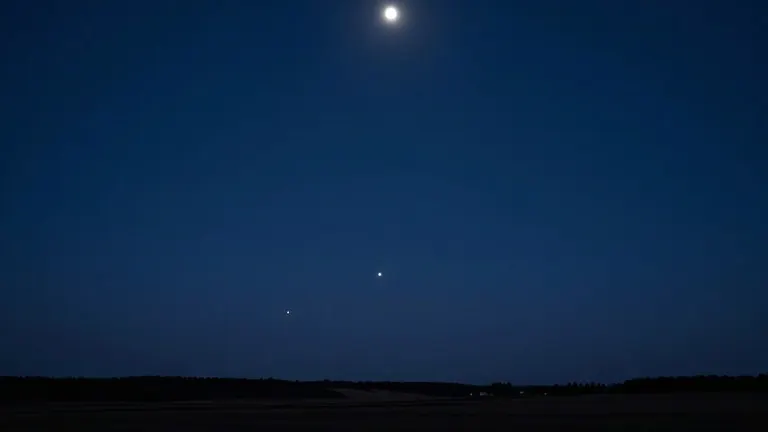
Trace Dominguez, host of Star Gazers, says the Moon, Mars, and Jupiter will form a distinct triangle in the sky on the night of November 23. The three objects will be close enough together that observers can see them without optical aid. Dominguez described the event as a "sandwich" in the sky, a visual arrangement that occurs when these specific celestial bodies converge in a small section of the horizon.
The alignment will be best viewed after sunset. Dominguez advises looking toward the southwestern sky. The Moon will be in its waxing gibbous phase, appearing as a bright, partially illuminated disc. Mars will appear as a faint orange dot. Jupiter will appear as a bright white point of light. The three objects will be spaced within a few degrees of one another, allowing the human eye to track them easily from the ground.
Dominguez noted that such alignments are not rare, but the specific combination of the Moon, a red planet, and the brightest planet in the solar system creates a memorable sight. He pointed out that Jupiter is currently at opposition, meaning it is directly opposite the Sun from Earth's perspective. This position makes Jupiter brighter and visible for most of the night. Mars is also well-placed for viewing, though it will be dimmer than Jupiter.
The host used the event to discuss the mechanics of planetary motion. He explained that planets do not sit in fixed positions. They orbit the Sun at different speeds, causing them to drift relative to one another from the perspective of an Earth-bound observer. When the Moon passes near their orbital path, it can visually overlap with or come close to these distant bodies. This event is a line-of-sight coincidence, not a physical collision or interaction between the objects.
Dominguez emphasized that no special equipment is required for this specific viewing opportunity. Binoculars or a small telescope can reveal surface details on the Moon, the two largest moons of Jupiter, and the rusty surface of Mars. However, the naked-eye view is sufficient to see the alignment. He suggested that viewers check local weather forecasts for clear skies on the evening of November 23.
The segment is part of the Star Gazers series, which provides regular updates on night sky events. Dominguez has covered previous alignments, including instances involving Venus and Saturn. He encourages viewers to use these events as a starting point for learning to navigate the sky. By identifying a few bright objects, observers can locate constellations and other celestial features.
Dominguez also addressed common misconceptions about planetary alignments. He clarified that the Moon is much closer to Earth than the planets. From our perspective, it appears large and moves quickly across the sky. Mars and Jupiter are much farther away and appear as points of light. The visual proximity is a result of perspective, not actual distance in space. The Moon is approximately 238,855 miles from Earth on average. Mars is roughly 225 million miles away. Jupiter is about 480 million miles away at this time of year.
Viewers can catch the Star Gazers episode on the Cascade PBS schedule. The segment runs for approximately five minutes. Dominguez provides step-by-step instructions for locating the objects. He notes that light pollution in urban areas may make Mars difficult to see, but the Moon and Jupiter will remain visible. In rural areas, all three objects will be easily distinct against the dark background of the sky.
The next major planetary conjunction of this type will not occur for several months. Dominguez suggests that sky watchers keep a calendar of such events. He lists other upcoming opportunities to view Mars and Jupiter individually. These objects will remain in the night sky for several weeks following the alignment. The Moon will change phase daily, moving away from the planets as the days pass. The planets will slowly drift eastward in the sky relative to the stars.
Source: Cascade PBS