NASA reassigns Mars rover spare parts to build PROMISE lunar vehicle
The agency plans to launch the nuclear-powered rover in 2028 to survey the Moon's south pole.
By Alessia Desai ·
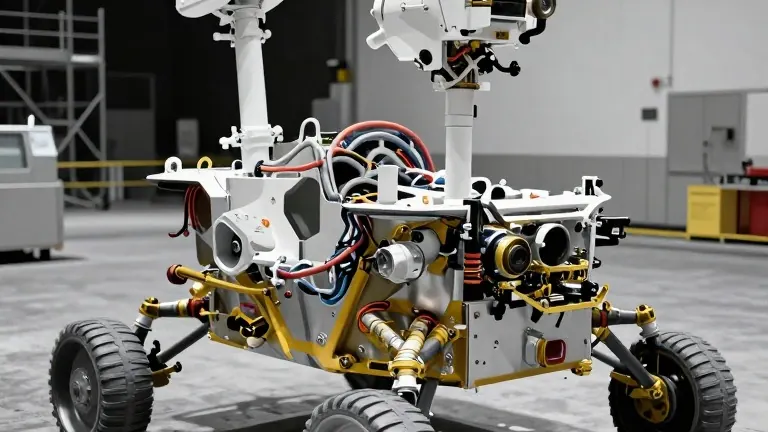
NASA will construct the PROMISE rover from hardware and test vehicles currently used for the Perseverance and Curiosity rovers on Mars. The agency announced this reuse strategy as part of a wider push to establish a human presence on the Moon. The new vehicle is designated for the lunar south pole.
NASA stated that the existing technology is compatible with the lunar environment. The agency determined that the hardware can tolerate the harsh conditions near the Moon's South Pole. Nuclear power will drive the vehicle to withstand the icy terrain.
In a news release, the agency noted that using proven hardware and software reduces costs. It also allows for a shorter timeline for integration and testing. The release said the Mars rover operation approaches apply directly to PROMISE.
NASA plans to launch PROMISE in 2028. The 18-month mission will investigate potential landing sites. The vehicle will drill into the ground and collect lunar dust. It will also explore the terrain with visible-light cameras, temperature sensors, radiation sensors, and spectrometers for chemical analysis.
Blue Origin received a base contract for the project. The contract includes an option period worth an additional $140 million. That option is contingent on performance to deliver the rover to the lunar South Pole.
The agency also issued contracts for Orbital Transfer Vehicles. These vehicles move cargo to the Moon. NASA awarded six task orders under the Venture-Class Acquisition of Dedicated and Rideshare launch services contract. Arrow Science and Technology, Blue Origin, and Impulse Space received these awards to integrate and transport Moon Base cargo.
Additional awards support the Mini-Communications and Solar Tower. Redwire, Yank Technologies, and Blue Origin's Honeybee Robotics were hired for this component. NASA also expanded its Commercial Lunar Payload Services initiative. Eight companies will help with future moon deliveries: Blue Origin, SpaceX, Firefly Aerospace, Intuitive Machines, iSpace US, Lockheed Martin Space, Voyager Technologies, and Northrop Grumman Space Systems. The new CLPS 2 framework is a 10-year master contract with a combined maximum value of $10 billion. The agency also increased the current CLPS 1.0 contract from $2.6 billion to $4.2 billion to support initial Phase One Moon Base objectives.