Portland museum offers free access to 150 rarely seen Kapoor prints
The Jordan Schnitzer Museum of Art hosts the artist's first print-focused retrospective, featuring works that challenge viewers to find their own meaning in abstract forms.
By Meera Fletcher ·
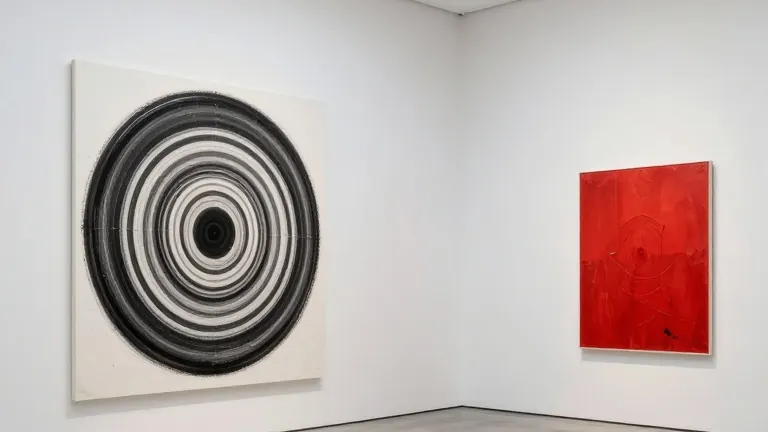
Anish Kapoor, the Mumbai-born artist who represented the United Kingdom at the 44th Venice Biennale and won the Turner Prize the following year, has long been associated with monumental sculptures like Chicago's Cloud Gate. However, his current exhibition at Portland State University's Jordan D. Schnitzer Museum of Art shifts the focus away from these three-dimensional landmarks.
The show, titled Dissolving Margins, displays roughly 150 works spanning four decades of the artist's printmaking career. This marks Kapoor's first print-focused retrospective, offering a distinct look at his abstract compositions rather than the large-scale installations that defined his early fame. A sculpture titled The Mirror stands by the front desk, serving as a bridge between his sculptural work and the two-dimensional pieces dominating the gallery.
The exhibition features works that are not currently on display elsewhere, such as the Void Field sandstone collection and the 2009 piece Shooting into the corner, which fires blood-red wax at white corners every twenty minutes. While these specific sculptures are absent from the current show, they contextualize the themes of emptiness and intensity that permeate the prints.
Alexis Garcia, the program and outreach coordinator for the museum, noted that Kapoor rarely provides definitive explanations for his work. There is never a right or wrong interpretation. He really likes to leave space for you as a viewer to interpret it, Garcia said. This open-ended approach is central to the experience, requiring visitors to engage actively with the visual elements rather than passively consuming a stated message.
Color, particularly red, serves as a primary inspiration for the artist. Garcia explained that Kapoor remembers color very vividly, often referencing its cultural and spiritual connotations in India. He thinks a lot about the spice markets as a kid and seeing spices in baskets or pigment in baskets, Garcia said. These memories manifest in the vibrant hues and pigmentation found throughout the printmaking collection.
The visual complexity of the works often creates optical illusions. Garcia pointed out that the Workflow Now series, featuring quadrant boards, appears to pulsate and breathe to the viewer. Another piece, Mirror, plays with scale and perception in ways that shift depending on the observer's position. These effects require sustained attention to fully appreciate, transforming static images into dynamic visual experiences.
One of the most engaging sections is the black and white collection titled History, created in 2007 and located in the museum's basement. Moriah Conkel, a gallery attendant, observed that visitors spend the most time with these works. I like his attempt at capturing infinity or this sense of expansiveness, Conkel said. She noted that the pieces seem to reach into infinite dimensions, exploring concepts of what comes after life or before birth.
Conkel emphasized that the meaning of the art is entirely up to the viewer to create. You have to be willing to tell your own story, she said. The goal is for visitors to let the colors spark their own memories and associations, turning the experience into a form of self-reflection rather than a lecture on artistic intent.
Madi Hagebush, another gallery attendant, highlighted the cultural depth of the exhibition. Hagebush noted that Kapoor has collaborated with artists from various parts of the world, embedding his personal history and background into the work. I feel like there's just so much of that at PSU, and I feel like everybody could probably find a little spot of their story or their culture in the art, Hagebush said. Her favorite piece, Mother of Light from 1991, uses shades of brown to explore maternity and the void.
The exhibition is free to the public. The museum is open from 11 a.m. to 5 p.m., Tuesdays through Saturdays, with extended hours until 7 p.m. on Thursdays. The show will remain on view until Dec. 5, 2026.
Source: Portland State Vanguard