Thirteen Staff Arrested After Pillow Restraint Kills 32-Year-Old Patient in Croatia
Security footage of Kristian Josip Peris’s death at the Sveti Ivan Psychiatric Clinic sparked protests in Zagreb and exposed similar abuse in Bosnia, leading to widespread arrests and a 60-day deadline for staffing fixes.
By Tomas Rahman ·
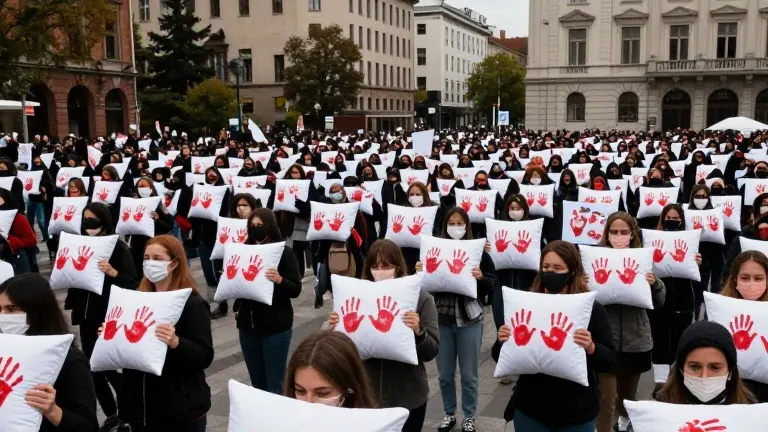
Thirteen healthcare workers have been arrested following a series of abuse incidents at psychiatric facilities in Croatia and Bosnia and Herzegovina. The legal actions followed the release of security footage showing staff restraining a patient with a pillow, a method that ended in death. These events have triggered a public demand for systemic changes in how mental health care is delivered in the region.
The crisis began at the Sveti Ivan Psychiatric Clinic in Zagreb. Kristian Josip Peris, a 32-year-old patient, died after medical staff allegedly placed a pillow over his face to restrain him. On Saturday, thousands of demonstrators gathered in Ban Josip Jelacic Square in Zagreb to protest. Many participants carried white pillows marked with bloody handprints as a tribute to Peris. The visual evidence of the restraint method quickly spread across social media and local news outlets, fueling anger across the country.
The outrage expanded to neighboring Bosnia and Herzegovina within days. Video from a public hospital in Zenica showed medical staff physically assaulting a patient in a psychiatric ward. The combination of these two high-profile cases led to the arrests of at least 13 staff members. The heads of the involved institutions in both countries have also resigned. These developments highlight the pressure on public authorities to manage the region's mental health infrastructure.
Croatia and Bosnia and Herzegovina, both former Yugoslav states, have spent three decades attempting to align their healthcare systems with European standards. Croatia joined the European Union in 2013, while Bosnia continues to pursue membership. Unlike Western nations where private providers play a major role, psychiatric inpatient care in these countries is predominantly delivered through public institutions. This structure places the burden of staffing, supervision, and access entirely on the state.
Edin Bjelosevic, a neuropsychiatrist and university professor from Zenica, noted that legal frameworks in former Yugoslav countries reflect contemporary standards. He stated that the challenge lies in consistently following those protocols rather than in accessing modern treatments. The region faces distinct resource gaps. According to Eurostat data from 2024, Croatia had 19.1 psychiatrists per 100,000 people, which is above the European average. In contrast, Bosnia and Herzegovina had just 9.48 psychiatrists per 100,000 people based on 2020 World Health Organization data.
Hospital bed availability also varies significantly. Croatia has 93 psychiatric beds per 100,000 people, exceeding the European average of 71. Serbia has 82, while Bosnia and Herzegovina has 40. Experts argue that these raw numbers do not fully capture the quality of care or the working conditions of healthcare professionals. The Croatian Ombudswoman previously recommended better training for staff on the use of coercive measures, which are intended as a last resort to prevent immediate harm.
Following Peris's death, the Croatian Ministry of Health identified faults in staff training, supervision, and record-keeping at the Sveti Ivan clinic. An inspection found that staffing levels did not meet required standards, specifically noting a shortage of one physiotherapist and one nursing assistant. Health Minister Irena Hrstic stated that four of five ordered corrective measures would take effect immediately. The clinic was given 60 days to fix the remaining staffing issues.
Abdulah Kucukalic, a neuropsychiatrist from Sarajevo, emphasized that psychiatric institutions in the region suffer from a shortage of non-medical personnel trained to handle acute crises. He warned that having only one doctor and two healthcare workers on duty is often insufficient to manage patients in severe acute conditions safely. This risk is particularly high during late afternoon and night shifts when staffing is at its lowest. The recent arrests and resignations mark the latest chapter in a long struggle to ensure safety in these public facilities.