Trump signs bill ending U.S. penny production after 250 years
The Common Cents Act officially halts the minting of the penny, a coin in circulation since 1793, citing cost inefficiencies and shifting to a nickel-based standard for small change.
By Tomas Rahman ·
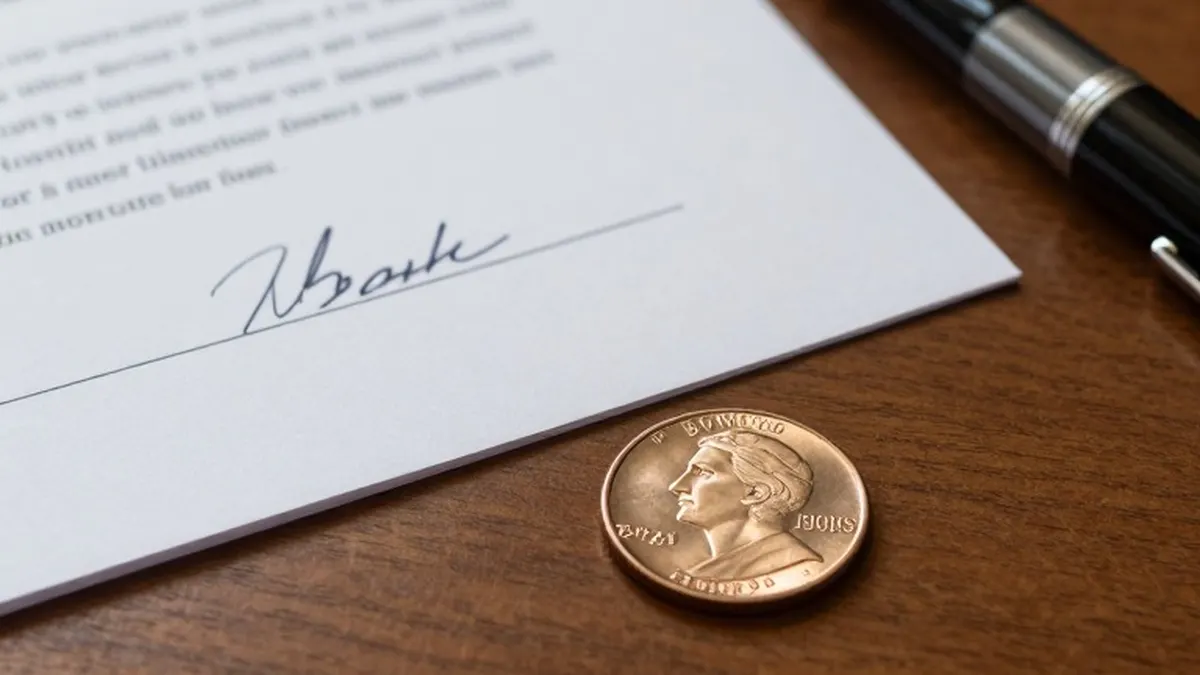
President Donald Trump signed the bipartisan Common Cents Act on Friday, formally directing the federal government to cease the production of the penny. The legislation marks the end of nearly 250 years of continuous coinage for the one cent piece, which was first produced by the U.S. Mint in 1793 following the passage of the Coinage Act in 1792. The bill passed both the House of Representatives and the Senate by voice vote, indicating a lack of notable opposition from either party.
The primary driver for the legislation is the high cost of manufacturing the coin relative to its face value. Rep. Lisa McClain, a Republican from Michigan and the author of the bill, highlighted this disparity in a post on X on September 29, the day after the Senate approved the measure. She stated that it costs nearly four cents to produce a single penny, arguing that the change would save the government $85 million annually by permanently ending production. While the U.S. Mint had previously estimated immediate annual savings at $56 million, the new law aims to secure these financial benefits long term.
Although the physical minting of standard circulation pennies stopped in November 2025, this new act makes the decision permanent. The government had halted production nine months after Trump initially called for the Treasury Department to stop the process, describing the effort as wasteful. Despite the end of regular production, the U.S. Mint indicated that it will continue to create collector versions of the coin in limited quantities for numismatists and enthusiasts.
The law clarifies that existing pennies remain valid legal tender for all debts, public charges, taxes, and dues. The Treasury Department has stated that the Federal Reserve will continue to recirculate the approximately 114 billion pennies currently in existence for as long as possible. To facilitate the transition in the cash economy, the measure provides a procedure for businesses that accept cash payments, allowing them to round transaction amounts to the nearest value divisible by five cents.
With the penny removed from the bottom of the currency hierarchy, the nickel assumes that role. The new legislation permits the nickel to be manufactured using a more cost-effective composition. Previously produced with a mix of nickel and copper, the coin can now feature an inner layer of zinc with an outer layer of nickel. This change mirrors the composition of the former penny and is expected to reduce production costs further.
The penny has undergone numerous design changes since its inception. The first coin produced in 1787 featured a sundial design created by Benjamin Franklin. After the U.S. Mint took over production, the coin was slightly larger and depicted a woman representing Liberty on one side and 15 chain links on the other. In 1857, the design shifted to a flying eagle on one side and a wreath on the other, while the material composition changed from 100 percent copper to a blend of 88 percent copper and 12 percent nickel.
Two years after the 1857 redesign, an Indian Head design was added to one side of the coin. It was not until 1909 that the penny received its most recognizable modern face, featuring President Abraham Lincoln. The most recent design issued by the U.S. Mint was introduced in 2010 under the Union Shield theme. This version displays a shield on the reverse side, which the Mint explained represents Lincoln’s preservation of the United States as a single country.
More News · National news · Report a business · Got a Story?