UK Households Build Reserves After Government Sets Three-Day Supply Target
Families are adjusting weekly shopping habits to meet new official guidance, citing concerns over Russian threats and climate-related infrastructure risks.
By Meera Fletcher ·
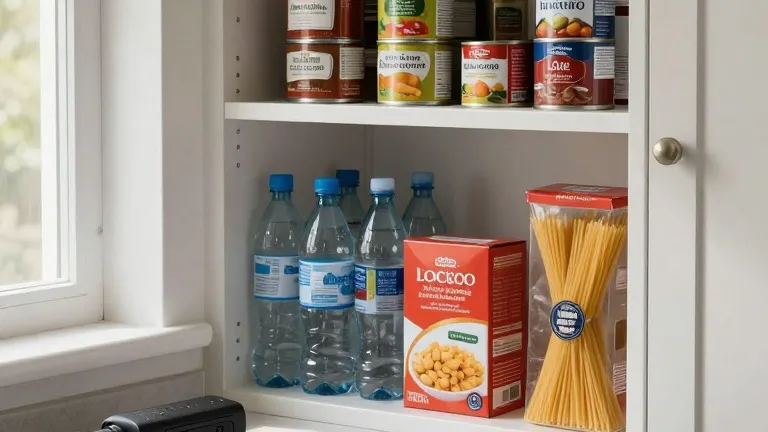
Lawrence Barratt in Hythe, Hampshire, has altered his weekly grocery routine to include tinned beans, soups, chilli con carne, noodles, and rice. He is also purchasing bottled water in small quantities. His goal is to secure enough food and water for two people for three days, a duration now recommended by the government.
The UK government launched its Be Ready campaign on Thursday. The initiative urges residents to store three days' worth of essential supplies to handle various emergencies. While the official push began this week, many households had already started preparing as ministers issued similar warnings for months.
Barratt began his preparations about two weeks ago after seeing the advice online. He cited the empty supermarket shelves during the initial 2020 lockdown as a primary motivator. The campaign website convinced him that he was previously unprepared for any major disruption. He is also gathering a first aid kit, a battery-powered FM radio, a torch, and a portable power bank.
In Greenwich, London, Marco Camurri is assembling a similar stockpile. His list includes pasta, passata, stock cubes, tinned food, bottled water, medicines, and toilet paper. He noted that his family began preparing a few months ago following reports of supply chain disruptions linked to El Niño. Because the family consumes these items in their regular diet, he described the extra cost as equivalent to one additional week of staple shopping.
Camurri's household maintains a small woodpile in the garden for boiling water or heating. They keep power banks charged, store USB rechargeable flashlights, and aim to keep their car fuel tank above 50 percent, which provides roughly 300 miles of driving range. The family is currently tracking expiry dates for their supplies in a spreadsheet to ensure items are rotated before they spoil.
Jack Davenport in North Shields also points to El Niño as a catalyst for his stockpiling efforts. He described the current threat environment as difficult to gauge in size. He listed climate disasters, Russian shadow threats, artificial intelligence risks, and interest rate hikes driven by energy insecurity as key concerns. Davenport argued that the country's physical and technological infrastructure is aging and outdated.
He suggested the government aims to reduce long-term panic by framing these events as possible rather than certain. He noted that several generations have not experienced the hardship that was common before the war, making the new guidance a necessary recalibration of expectations.
Not all residents share this level of urgency. Deirdre O'Sullivan in Leicester called the new guidance "daft." She compared it to 1970s advice to hide under tables during nuclear attacks. O'Sullivan argued that the three-day target is inadequate for a genuine emergency. She stated that any danger to drinking water should be anticipated more precisely and that extreme food shortages would likely unfold over a much longer period.
O'Sullivan described the policy as a bureaucratic exercise. She said the advice resembled a measure designed to demonstrate that a policy exists, even if that policy is clearly totally useless.