26.3% of young adults in the EU face poverty risk as protests sweep Europe
Student-led demonstrations in Serbia resulted in the ouster of President Aleksandar Vucic, a milestone that has energized similar movements across the continent.
By Meera Fletcher ·
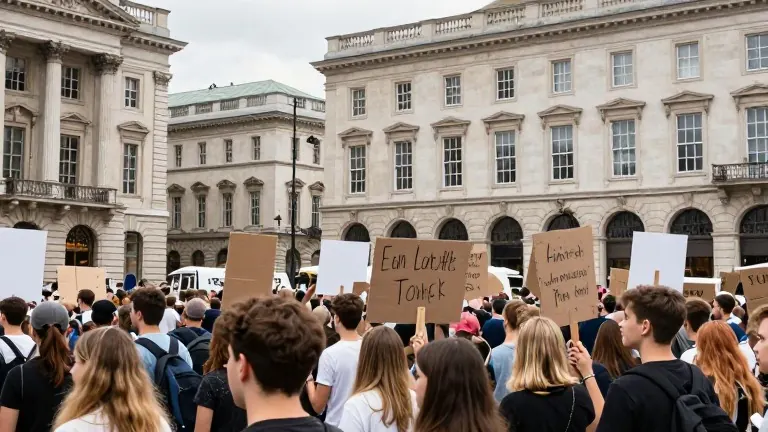
Student-led protests across Europe have shifted from sporadic demonstrations to a coordinated movement capable of removing long-standing leaders. In Serbia, nearly two years of rallies against perceived corruption and authoritarianism ended this weekend with the toppling of President Aleksandar Vucic. The outcome has galvanized similar groups in France, Italy, Albania, and Belgium, who cite overlapping grievances regarding housing, education, and economic stagnation.
The financial pressure on young people is documented in recent European Union data. A 2025 survey found that 40% of individuals aged 16 to 30 cite rising prices and the cost of living as a primary concern. Of the 92.7 million EU residents at risk of poverty or social exclusion in 2025, the highest risk group was young adults aged 18 to 24, with a rate of 26.3%. This compares to a risk level of 18.8% for adults aged 65 and older. Younger voters also express frustration over inheriting the financial obligations of older generations, who tend to turn out for elections at higher rates.
In France, the demographic divide is stark. According to the OFCE think tank, people over 60 comprise a quarter of the population but hold 60% of the national wealth. French pensions represent the largest public expense, projected to reach 14% of economic output. While this figure is lower than the roughly 16% of GDP spent in Greece and Italy, it remains far above the less than 4% spent in countries such as Australia, Chile, and South Korea. A French government report from October noted that pension spending rose by 2.5 percentage points of GDP between 2000 and 2023, while education spending declined by 0.5 percentage points. Consequently, 32% of the education ministry's budget now goes toward pensions, reducing funds available for other sectors.
Protesters on the ground describe conditions that have pushed them from passive discontent to active unrest. Stasa Piletic, a student protester in Serbia, described the feeling after Vucic's departure as one of relief and freedom, marking a transition from protests to responsibility. In Milan, Chiara, a 21-year-old student, said the ruling class stole the ability for her generation to imagine a future. She described schools lacking teachers and crumbling infrastructure, coupled with underpaid jobs and overpriced housing. In a suburb north of Paris, 17-year-old Bilal Narjissi recalled rats in his school and a roof collapse that forced a evacuation last year. He stated that the protests proved young people in Europe are united in the belief that they are treated like children and are not listened to.
The movement has also intensified in Albania. Student demonstrations against Prime Minister Edi Rama have engulfed Tirana and spread to other cities, driven by anger over corruption and poor education standards. Xyke Kurti, a 19-year-old architecture student, said the prime minister spent 130 days ignoring the students. She noted that when asked where they see their future, most students answer that it is outside the country, because connections often beat talent at home. In Brussels, 19-year-old Maya Gourdel, who has protested for better school conditions, said that passive efforts were ignored until visible actions like burning trash drew media attention.
The next scheduled demonstration is planned for this weekend in Germany. Protesters there will march over the cost of living, inequality, war, and the state of schools. The movement continues to expand beyond the initial flashpoints in Paris and Belgrade, with participants in various nations linking their local struggles to a shared European discontent.
Source: The Jerusalem Post