UK Grid Strategy: £4,000 Credit for Bidirectional EV Tech
Government consultation proposes financial incentives for carmakers to install vehicle-to-grid technology, potentially easing zero-emission sales mandates.
By Alessia Desai ·
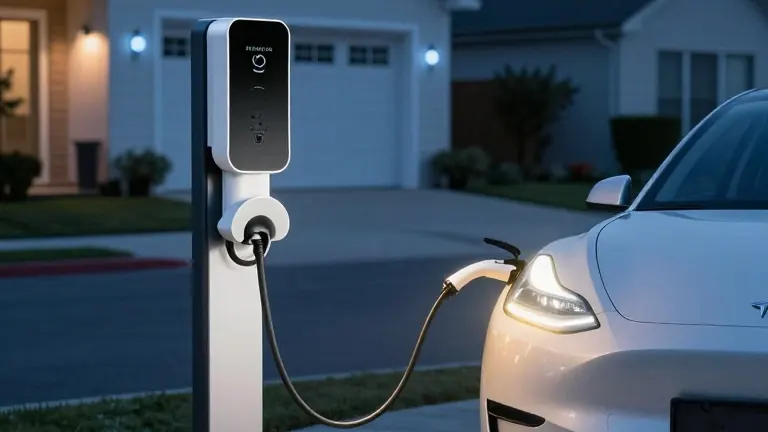
A single credit worth approximately £4,000 would allow UK carmakers to sell an additional petrol vehicle without facing fines, according to plans detailed in a government consultation that closed on Friday, October 23, 2026.
The proposal is part of a review of the zero-emission vehicle (ZEV) mandate. It suggests giving manufacturers incentives to add vehicle-to-grid (V2G) technology to electric cars. This technology, also known as bidirectional charging, enables vehicles to store energy and release it back into the electrical grid or the driver's home.
Ministers aim to use this mechanism to help balance the national grid. As the UK transitions from fossil fuels to renewables, demand often outpaces supply during still or dark periods when wind and solar generation is low. V2G technology could allow millions of electric vehicles to act as mobile power plants, reducing the need for expensive gas power plants to fill supply gaps.
The system would work by automatically charging vehicles when electricity is cheap, typically overnight. Drivers could then sell some of that stored power back to the grid during times of high demand. The government noted that smart charging tariffs already help manage oversupply, but V2G offers a solution for peak demand periods.
Environmental groups raised concerns that the incentives could have a counterintuitive effect. By allowing carmakers to trade V2G credits for exemptions from ZEV targets, the policy might enable manufacturers to sell more polluting petrol models in the coming years.
Ben Nelmes, chief executive of the New AutoMotive thinktank, argued that carmakers should only receive rewards if the technology is actively used, not merely installed. He stated that under the proposals, credits worth around £4,000 would be issued for kit that costs manufacturers a few hundred pounds. Nelmes warned that few drivers own the expensive chargers required to use the technology, meaning shareholders might benefit more than billpayers.
Vicky Edmonds, chief executive of the Electric Vehicle Association England, described the timing as premature. She noted that while millions of UK drivers own electric vehicles, only a fraction currently use vehicle-to-grid or storage technologies. Edmonds said consumers are still focused on immediate concerns such as vehicle cost, charging prices, and daily utility, making it too early to grant credits for a technology not yet tested at scale in the real world.
The government is also preparing to cut electric vehicle sales targets under the ZEV mandate. Environmental groups anticipate these changes could result in an additional 147 million tonnes of carbon emitted into the atmosphere by 2050.
Currently, some drivers sell electricity back to the grid through companies such as Octopus Energy in the UK, Renault in France, and BMW in Germany. Octopus Energy claims drivers can save £620 a year using the service.
The National Energy System Operator, which balances Great Britain’s grid, forecasts that V2G cars could provide the equivalent of a power station by 2030. The operator estimates this capacity could reach 1.2 gigawatts on demand by that year. By 2050, Neso forecasts the capacity could grow to 41 gigawatts, enough to meet more than a quarter of peak energy demand.
Source: The Guardian