135 Detained as France Tightens Grip on Cost-of-Living Unrest
French authorities deployed massive security forces to prevent a repeat of last week's chaos, resulting in significant arrests and shifts in protest routes across major cities.
By Valentina Cruz ·
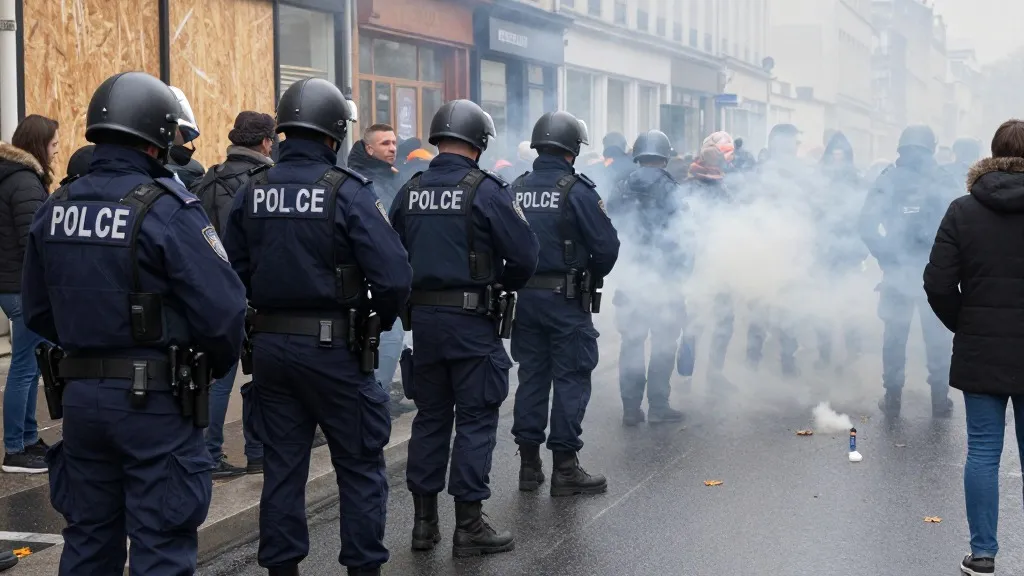
Security forces in France have intensified their presence in major urban centers, leading to the detention of 135 individuals and the use of tear gas to manage demonstrations on Saturday. This escalation marks the second consecutive weekend of significant public unrest driven by rising living costs. The strict measures were designed to prevent a recurrence of the disorder seen in the previous week, when more than half a million citizens joined the movement. Authorities aimed to project control while allowing for continued expression, resulting in a complex landscape of authorized marches and dispersed crowds.
The current wave of protests has a distinct trajectory that began last month. It started with high school students in the southeast of Paris advocating for better conditions. The movement quickly expanded as broader segments of the population joined in, demanding relief from the high cost of goods and services. This growth set the stage for the large-scale turnout observed last week, which prompted the interior ministry to prepare for a potentially larger crowd this Saturday. The shift from student-led actions to a national economic protest has defined the political landscape in recent weeks.
Interior Minister Laurent Nuñez reported that security teams had seized a variety of items from detainees, including metal balls, lead pellets, fireworks, slingshots, steel balls, improvised weapons, a katana, and airsoft weapons. He noted that up to 70,000 officers were deployed, supported by helicopters, armored vehicles, and water cannons. Despite the heavy show of force, Nuñez stated that there had been no major incident in the country thus far. The sheer scale of the deployment suggests a strategy focused on containment and rapid response rather than allowing large crowds to consolidate.
In Lyon, where demonstrations had been officially banned, approximately 150 protesters near the city center attempted to block a road before police used tear gas to clear the area. A 21-year-old student who spoke to Agence France-Presse anonymously described the police tactics as highly mobile, noting that officers would disperse marches before they even fully formed. In Orleans, thousands marched against a congress for Marine Le Pen's National Rally party. Police counted 11,000 participants, while organizers claimed the number was 26,000. The crowd chanted slogans targeting both the current president and the opposition leader, highlighting the dual focus of the public dissatisfaction.
In Paris, authorities described the atmosphere as calm during the city's only authorized march at the Porte d'Italie. The route was moved at the last minute from the Bastille to a more remote southeastern location, a change that union organizers accepted reluctantly. Murielle Guilbert, a union representative, called the restriction scandalous, arguing that wages had not risen sufficiently. Meanwhile, the disruption has affected daily life significantly, with major museums closed and many businesses boarding up their windows. Around 3,000 shops across France were damaged or looted in the previous week's events, underscoring the economic impact of the unrest.
The movement shows no signs of slowing down. The Yellow Vests, who emerged about eight years ago, have announced plans for further demonstrations on Oct. 31. They intend to hold rallies and a sit-in outside parliament and city halls, criticizing what they describe as an authoritarian drift in government policy. This domestic tension is part of a broader European trend, with similar protests occurring in Italy, Albania, Spain, and Portugal. The convergence of these movements suggests a shared frustration across the continent regarding economic stability and political responsiveness.
Source: CBS News