Voters Weigh Iran War and Cost of Living in 2026 Midterms
With polls open across the country, the decision on congressional control is being shaped by the ongoing conflict with Iran and high consumer prices.
By Alessia Desai ·
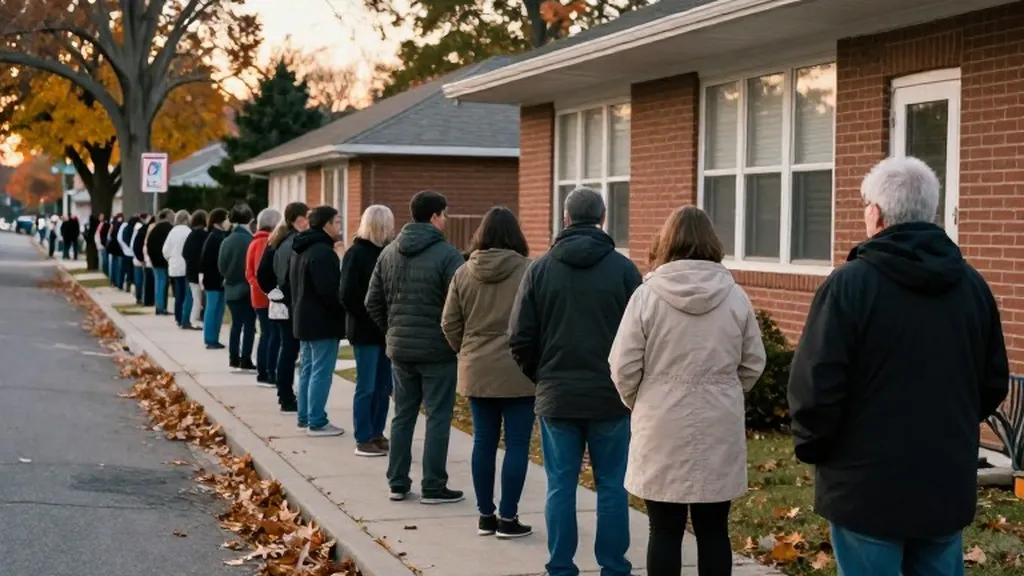
On Tuesday, November 3, 2026, American voters are casting ballots in a midterm election that will determine which party controls Congress for the final two years of President Donald Trump's second term. The Associated Press describes this contest as a referendum on the administration, with voters struggling with high prices and anger over an unpopular war with Iran. As polls open, the nation is deciding not just who will lead the legislative branch, but how the administration's foreign policy and domestic spending priorities will be checked or supported.
The war with Iran has emerged as a central issue on the ballot, complicating a political landscape already strained by economic concerns. According to AP-NORC polling, only 35 percent of U.S. adults approve of Trump's job performance, and the administration's handling of the economy has an even lower approval rating at 25 percent. About seven in ten Americans say the country is heading in the wrong direction, with most blaming the president for high prices. This dissatisfaction provides a backdrop for the Iran conflict, which voters are weighing against their daily financial realities.
In the U.S. House, all 435 seats are up for grabs. Republicans currently hold 218 seats, while Democrats hold 214, with one independent and vacancies remaining. Democrats need a net gain of three districts to secure a majority, a threshold that Ballotpedia suggests is achievable given the 46 battleground districts identified. The Associated Press notes that Republicans were bracing for a potential loss in the House, acknowledging that one or two seats could tip the balance in either chamber. The outcome here will directly influence the administration's ability to pass legislation and conduct oversight.
The Senate race is equally pivotal, with 35 seats in play, including 33 regular elections and two special elections. Republicans hold 53 seats, while Democrats hold 45, plus two independents who caucus with Democrats. Democrats need a net gain of four seats to take control, a goal that requires victories in states with varying presidential margins. Ballotpedia lists 13 Senate races as battlegrounds, including states like Maine, where the AP notes that economic strain and tariffs have made the race competitive. The result in these states will determine whether the Senate can block or advance the administration's agenda on the Iran war and other foreign policy decisions.
The financial stakes of this election are historic, with the 2026 races likely to be the most expensive in history. According to an AP analysis of AdImpact data, 88.1 percent of Republican general election TV ad spending went to states and districts that Trump won in 2024. This includes more than $850 million spent in areas where he won by 10 points or more. Republican committees outraised and outspent their Democratic counterparts, aided by Trump-affiliated groups and Elon Musk, though Democrats outraised their opponents at the candidate level. This spending disparity reflects the intensity of the fight for control, particularly in districts where the war and economic costs are most visible to voters.
Voters on the ground are expressing their concerns in straightforward terms. James Moore, a 57-year-old librarian in Raleigh, North Carolina, told the Associated Press, "I'm paying more taxes. I'm paying more for my healthcare. I'm paying more for everything." His comments mirror the broader sentiment of a electorate focused on the cost of living. In contrast, Mark Barker of Palm Beach Gardens, Florida, said he has been following Trump closely and believes he is doing an awesome job. These diverging views highlight the polarization that defines this election, with the Iran war and economic management serving as the primary fault lines.
The administration's approach to the election has included active campaigning and legal challenges. President Trump held dozens of rallies, ending his schedule on Sunday in Salina, Kansas, where he urged voters to pretend he was on the ballot. His administration has also filed lawsuits in Alaska and California related to voting certification and noncitizen voting, moves that Democrats fear could lead to interference. A federal judge temporarily barred the administration from carrying out a plan to prevent noncitizen voting, a decision that critics say protects states' authority over elections. These legal battles add another layer of complexity to a race already defined by high stakes and strong emotions.
For Democrats, the path to a majority requires capitalizing on voter anger over the war and the economy. DCCC Chair Rep. Suzan DelBene stated, "The American people are angry. They want change." If Democrats win either chamber, investigations and possible impeachment proceedings become likely, with House Democratic Leader Hakeem Jeffries outlining a 100-day agenda focused on the cost of living and oversight. A strong Democratic night would also boost potential 2028 candidates and complicate the path for Vice President JD Vance. The party remains cautiously optimistic, believing that the combination of economic pressure and the unpopularity of the Iran war will drive turnout in their favor.
Republicans, meanwhile, are fighting to hold the Senate and limit their losses in the House. RNC Chairman Joe Gruters emphasized, "Everything depends on turnout. If we turn out our voters, we win, and that's what we've been planning for." The party has relied on redistricting in states like Florida, California, and Texas to create more favorable maps, though the AP notes that new districts may not vote as drawn. The challenge for Republicans is to counter the narrative that the administration's foreign policy and economic management have failed to deliver stability. They must convince voters that a Republican Congress is essential for maintaining the momentum of the Trump agenda, including its stance on Iran.